Matters
Teach like it
Learning that sticks. Improvement that lasts.
— THE PROBLEM
Why most professional development doesn't change anything.
The history of school improvement in America is largely a history of programs. Some of those programs were well-designed. Some were backed by real evidence. Almost all of them, at scale, over time, failed to produce lasting change — not because the programs were wrong, but because programs are the wrong unit of analysis.
A program transfers knowledge. It tells people what to do. What it cannot do is change how a person actually practices. Practice is not changed by information. It is changed by sustained, structured experience over time, inside the actual conditions of the work, with someone who can see what you are doing and help you do it differently.
What Conscious Schools builds is different. Not programs. Conditions. The specific, structural result of how a school develops its educators — from the newest teacher to the system leader shaping conditions across dozens of campuses. When the conditions are right, student thriving follows. Not as a downstream benefit. As the direct expression of what those conditions actually are.
186
SCHOOLS IMPROVING INSTRUCTION USING CONSCIOUS SCHOOLS PRACTICES
132,000+
STUDENTS’ LIVES IMPROVED BY CONSCIOUS SCHOOLS WORK
97%
OF 5,500+ PD PARTICIPANTS RATE OUR TRAINING AS HIGHLY EFFECTIVE AND ENGAGING (OVER 9 YEARS!)
$3,100,000
IN AVOIDED NEW TEACHER REPLACEMENT COSTS AFTER NEW TEACHER TRAINING.
— OUR WORK TAKES THREE FORMS
Professional learning.
School improvement.
City hubs.
01
Professional Learning
Five cohorts for educators at every level — new teachers, master teachers, instructional leaders, campus leaders, system leaders. Year-long, job-embedded, cumulative, and built around our proven frameworks. The work that changes practice rather than adding to it.
02
School Improvement
Four structures for schools getting better together — not in isolation. School Improvement Collaborative, Critical Friends Visits, Bright Spot Visits, and On-the-Ground Support. Shared accountability. The difference between a school that improves and one that reverts.
03
City Hubs
The flagship model. All of the above, integrated and sustained, inside a consortium of schools doing the work together. Headwaters OKC is our first City Hub. It is a work in progress, and it is already producing results. For funders and cities serious about building shared infrastructure — this is where the conversation starts.
— WHAT THE RIGHT CONDITIONS PRODUCE
From 6% proficient to 48%.
While nearly doubling enrollment.
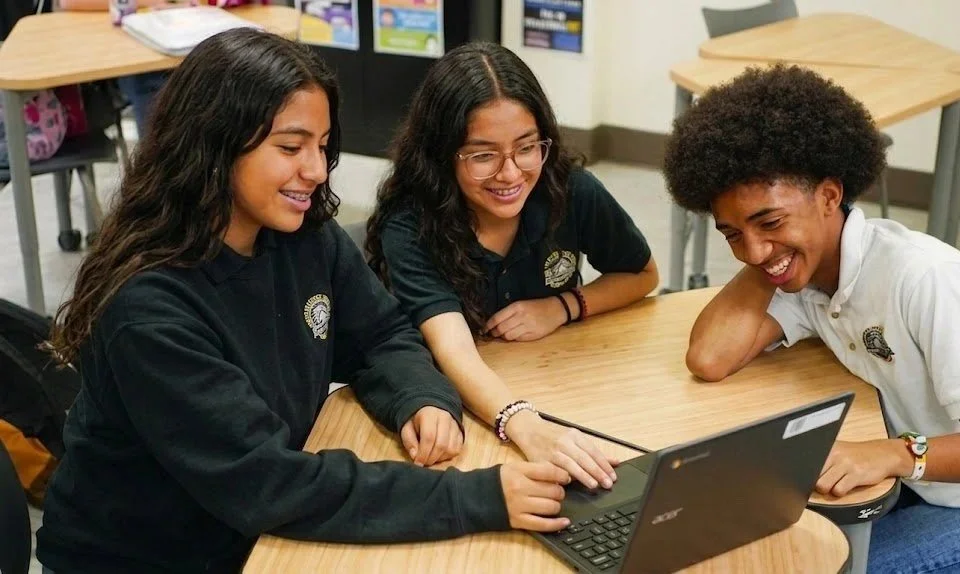
Santa Fe South Public Schools opened in a church basement in 2001. By 2019, only 6 percent of its students were proficient on state assessments. What happened next is one of the most striking improvement stories in urban public education.
Conscious Schools worked with SFS to invest deliberately in the conditions that produce quality — intensive teacher development, coaching-centered leadership, a culture of growth. Proficiency rose from 6 percent to 48 percent over five years. Enrollment grew from 3,278 students to over 5,200. A school system that is 95 percent Hispanic, 83 percent economically disadvantaged, moved from near the bottom to among the strongest in the state — while nearly doubling in size.
That is not a program result. That is a conditions result.
6% → 48%
DISTRICT PROFICIENCY (2019-2025)
3,278 → 5,200
STUDENT ENROLLMENT
84%
STUDENTS MAKING 1+ YEARS OF ACADEMIC GROWTH
— WHERE SCHOOLS BREAK DOWN
Schools fail at predictable points.
We build for each of them.
The failure points below are not random. They cluster at specific transitions — moments where the system asks something of its people that the system has not prepared them for. Each one is a place where conditions for student thriving are most commonly absent. Each one is a target for deliberate investment.
Foundation
No Shared Instructional Vision
Without a common language for great teaching, all other development is fragmented. Leaders see different things. Coaches give contradictory feedback. This is where Conscious Schools begins — before anything else.
Failure Point 1
The New Teacher
Between 40–50% of new teachers leave within five years. Not for lack of commitment — for lack of conditions that let them survive and grow. The field loses them before they become good. Students absorb the cost, year after year, invisibly.
Failure Point 2
The Master Teacher
The most experienced teachers in a building have stopped growing — not from indifference, but because the system has nothing left to offer them. Their ceiling becomes the school's ceiling. When they plateau, so does everyone around them.
Failure Point 3
The Instructional Leader
They were promoted because they were effective teachers — which means they were good at something personal, intuitive, and hard to articulate. Now they're expected to transfer that to colleagues with no preparation for what that actually requires. Most have no idea how to do it. It' is not their fault. They were never taught.
Failure Point 4
The Campus Leader
Leaders who haven't learned to lead through others cap the progress of their schools. A school whose improvement depends on the superhuman efforts of a principal doing everything has built dependency, not conditions. When the leader leaves, the gains leave. We teach campus leaders to lead better.
Failure Point 5
The System Leader
A school district or CMO is not a collection of inputs and outputs to be optimized — it is a web of relationships, feedback loops, and behaviors that no single lever controls. System leaders who recognize this stop trying to fix and start paying attention to patterns. The question is whether they know how to pay attention to the right things.